
Closed Cooling Towers for Clean, Water Saving Heat Rejection
A coil bundle inside the tower keeps your process fluid in a sealed loop while spray water and air remove the heat.
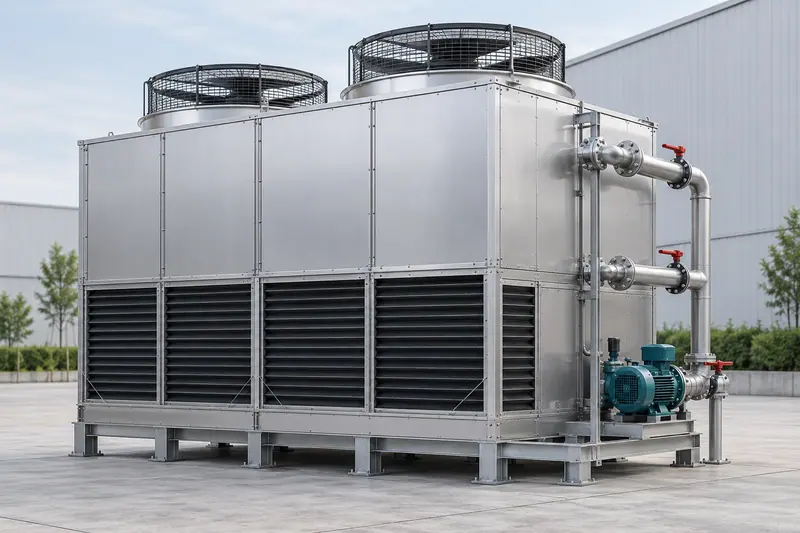 Illustrative
Closed Cooling Towers
In a closed circuit cooling tower, process fluid flows through the coil while spray water and air cool the coil from outside. The process fluid is never exposed to air or open water, which helps protect pumps, heat exchangers and process equipment.
Closed circuit cooling principle
A simplified view of a counterflow closed circuit cooling tower.
01
Hot fluid enters
Process fluid flows through the coil inside the tower. It stays sealed and never touches the air or spray water.
02
Spray and evaporation
Spray water falls over the coil. A small part evaporates and carries the heat away.
03
Air carries heat out
The fan draws air through the tower. Warm moist air leaves at the top, passing the drift eliminator.
04
Cooled fluid returns
Cooled fluid leaves the coil and returns to your process. Spray water drops to the basin and is recirculated.
Wet and dry combination (HKJS)
A simplified view of the wet-dry combination closed circuit tower.
01
Dry section first
Hot process fluid enters the dry finned coil, where ambient air cools it without using water.
02
Wet section finishes
The fluid then flows through the wet coil, where spray water evaporation removes the remaining heat.
03
Cool weather: spray off
When the air is cool enough, the spray can be stopped and the unit runs dry, saving water.
04
Closed loop stays clean
The process fluid stays sealed inside the coil throughout.
Composite flow (HKBF)
A simplified view of the composite flow closed circuit cooling tower.
01
Coil is sprayed from above
Process fluid flows through the coil while spray water coats the outside of the tubes.
02
Air and water flow together
A first stream of fresh air moves in the same direction as the spray water over the coil, which helps keep the tube surface wet and reduces dry spots.
03
Fill cools the spray water
Warm spray water then falls over PVC fill, where a second fresh air stream cools it before it is recirculated.
04
Cooler water on the coil
The cooled spray water returns to the coil, which helps reduce scaling and suits high-temperature fluids.
Why it matters
Clean closed loop
Process fluid stays sealed inside the coil.
Stainless steel coil
304 or 316 stainless steel options.
Water saving
Spray can be stopped in cold weather to save water.
Compact structure
Small footprint compared with open towers plus heat exchangers.
Easy maintenance
Access for inspection and cleaning.
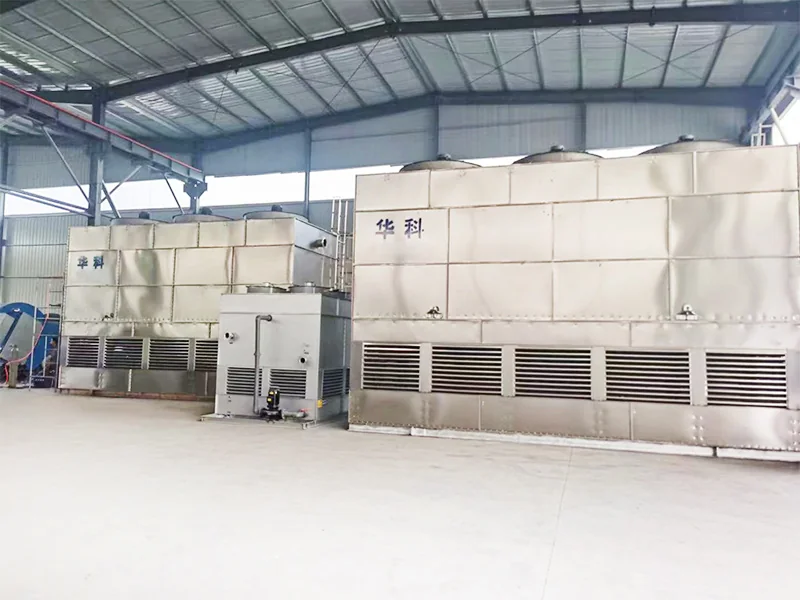
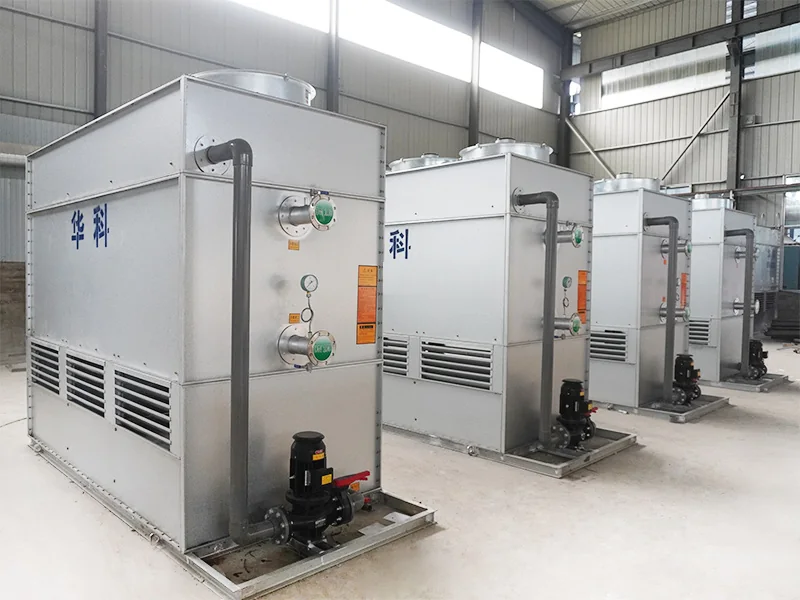
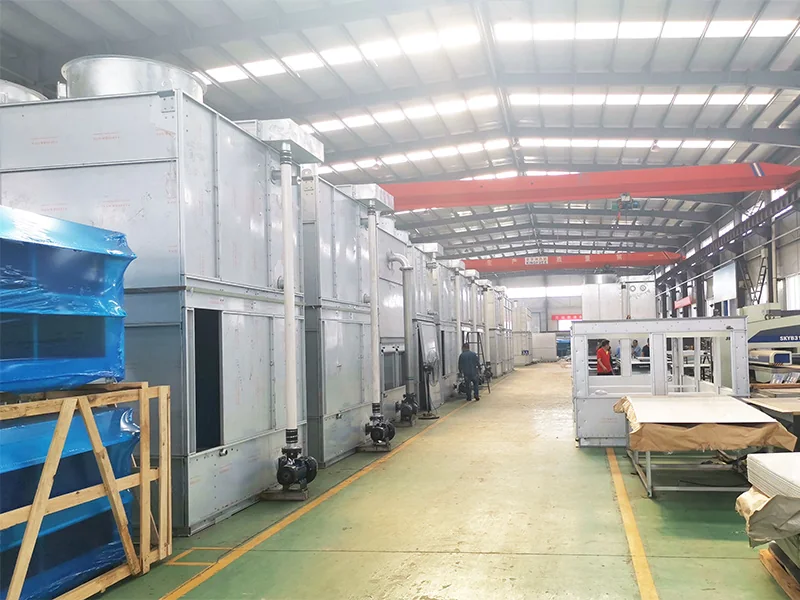
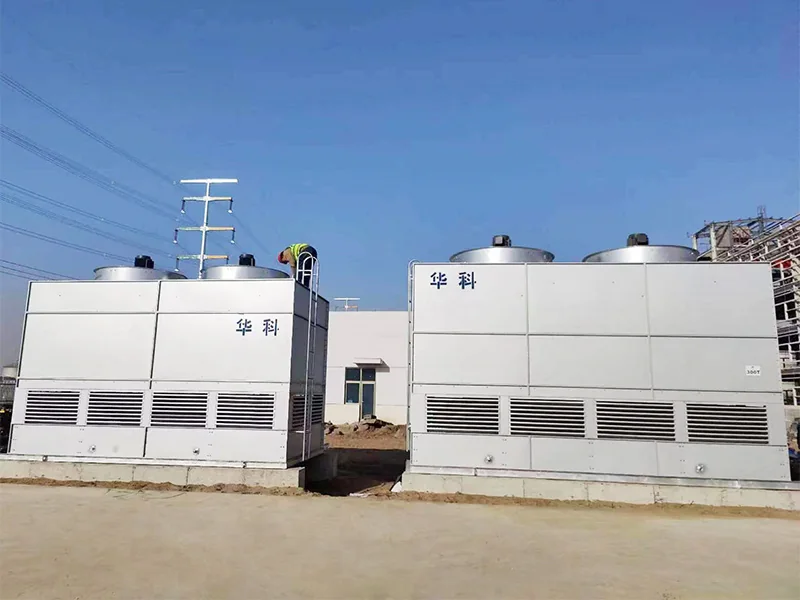
Photos from our production and projects
Models
HKBN counterflow
Compact structure and small footprint, suited to locations where ambient wet-bulb temperature is close to design conditions.
HKBF composite flow
Designed for high-temperature fluids and to help reduce scaling on the coil.
HKBH cross flow
Cross flow closed cooling tower.
HKJN water saving
Water saving closed cooling tower.
HKJS wet-dry combination
Combines dry and wet coil sections to cut water use.
Engineered to your requirements
Selection data
Model data, coil options and selection tables for the HKBN, HKBF, HKBH, HKJN and HKJS series are available on request. Send your flow rate, inlet / outlet temperature and wet-bulb temperature and we will recommend a model.
Need a recommended model?
Send your design conditions and an engineer will reply with a selection and quotation.